How to Find a Tumbler Niche Beyond YETI? I Mined 3 Blue Oceans with Amazon Market Deep-Dive
Step 1 confirmed the tumbler market is viable. But search "tumbler" on Amazon — the Top 10 are all YETI, Stanley, Hydro Flask, Thermos, each starting at 5000+ reviews.
Want a new listing to squeeze into that mainstream lane? You'll burn through your ad budget and still not rank on page one. This step solves exactly that: within the tumbler category, find the niche blue oceans the YETIs haven't taken.
What problem this step actually solves
Step 1 tells you whether "the whole tumbler market" is viable (macro); Step 2 tells you "which sub-niche within the market is doable" (micro). Specifically, 3 questions:
- ① Within the tumbler category, which sub-niches (kids/car/mini...) genuinely exist and have search volume?
- ② How high is each sub-niche's brand concentration? Do YETI/Stanley/Hydro Flask dominate?
- ③ Which sub-niches have a low review barrier + enough search volume + good YoY growth so a new listing can break in?
Why I stopped finding niches manually
My old manual method: search "tumbler" on Amazon, browse various sub-categories, look at Best Sellers lists, and note from gut "seems like not many kids styles" — then just go for it. The result was countless pitfalls.
❌ Finding niches manually
· Browsing sub-categories shows the same big brands
· Best Sellers lists don't show long-tail sub-niche brand distribution
· Guessing "is kids demand big" from gut, no data
· Can't see each sub-niche's Top5 share, average reviews
· Pick the wrong lane, burn ad budget = straight loss
✅ Using EasyClaw's Amazon Market Deep-Dive
· Calls Jungle Scout's official share_of_voice API
· Auto-aggregates brand-share data by sub-niche
· Produces an 8-sub-niche comparison table in one run
· Flags niches where YETI/Stanley don't dominate
· Runs in 5-8 minutes, 10× more accurate than by hand
Why I don't use Helium 10 Black Box — I use EasyClaw
Helium 10's Black Box is one of the most popular product-research tools out there. But it solves "finding products," not "finding niches." Those are completely different things:
🔍 Helium 10 Black Box (product level)
Gives you a product list (filtered by BSR / monthly sales / reviews)
→ but doesn't tell you the overall picture of the niche those products sit in
The biggest beginner pain:
· See a BSR-100 kids tumbler but don't know how many competitors the niche has overall
· Don't know how much share YETI holds in this niche
· Don't know if the niche's average review barrier is high
→ Decision granularity stops at "a single product," missing the "niche panorama"
🤖 EasyClaw's Amazon Market Deep-Dive (niche level)
Amazon Market Deep-Dive aggregates share_of_voice data by sub-niche:
· Splits the tumbler category into 8 sub-niches (kids / car / mini...)
· For each: search volume + Top5 share + average reviews + YoY
· See at a glance which niche has "YETI absent + has search volume + low review barrier"
This is the fundamental difference between niche-level and product-level. Product-selection decisions need niche-level data, not just products.
Here's how I had EasyClaw do this
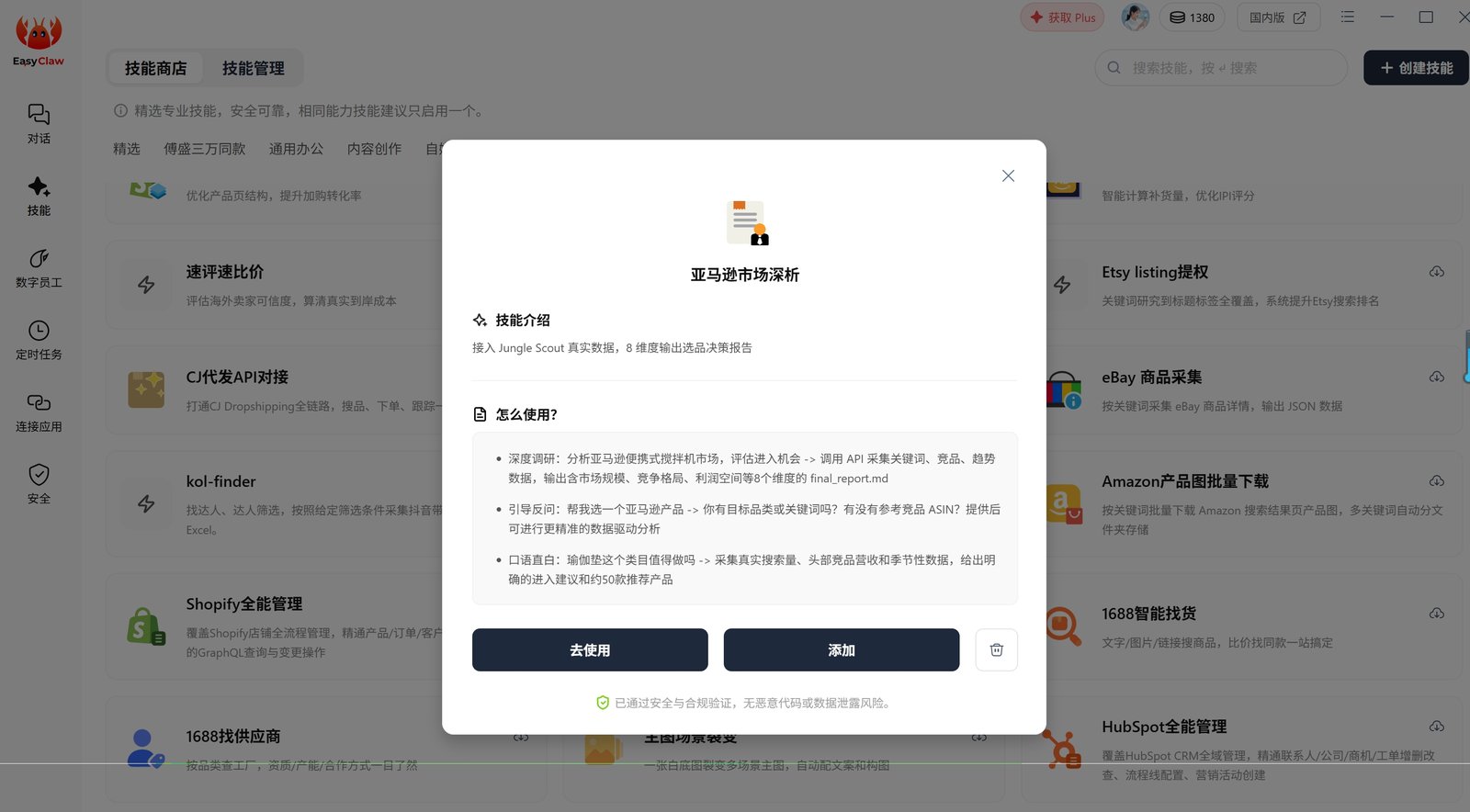
The steps: install the skill (skip if you installed it in Step 1 "Market check") → send the command to split niches → read the output.
📦 Amazon Market Deep-Dive
The same skill as Step 1 "Market check." This step mainly uses its share_of_voice API (brand share of voice) + product_database API.
use share_of_voice data to assess each one's brand concentration (Top5 share) + average review barrier + monthly search volume + YoY,
and flag the niches YETI / Stanley / Thermos don't dominate."
EasyClaw automatically runs the three APIs share_of_voice + product_database + historical_search_volume and aggregates by sub-niche.
The 8-sub-niche comparison report the skill produces
Amazon Market Deep-Dive auto-aggregates by share_of_voice data and outputs an 8-sub-niche comparison (data shape illustrative; final values depend on the skill's actual run):
| Sub-niche | Monthly searches | Top5 share | Avg reviews | YoY | Dominant brand |
|---|---|---|---|---|---|
| Standard 20oz Tumbler (adult general) | 9.8K | 72% | 3500 | +5% | YETI / Stanley |
| Kids Insulated Tumbler | 4.2K | 28% | 420 | +18% | Scattered (no monopoly) |
| Car Cup Holder Tumbler | 3.6K | 31% | 380 | +22% | Scattered (no monopoly) |
| Mini Pocket Tumbler | 2.1K | 24% | 290 | +35% | Scattered (no monopoly) |
| Wide Mouth Tumbler | 5.4K | 65% | 1200 | +8% | Hydro Flask |
| Sport Squeeze Tumbler | 2.8K | 38% | 510 | +12% | Scattered |
| Coffee Tumbler with Handle | 4.1K | 58% | 980 | +6% | Stanley |
| Beer Insulated Tumbler | 1.9K | 42% | 720 | +9% | Scattered |
Data shape is illustrative. Actual values vary by the skill's run timing / Jungle Scout data updates. → The previous step "Market check" already covered the source of these quantified standards.
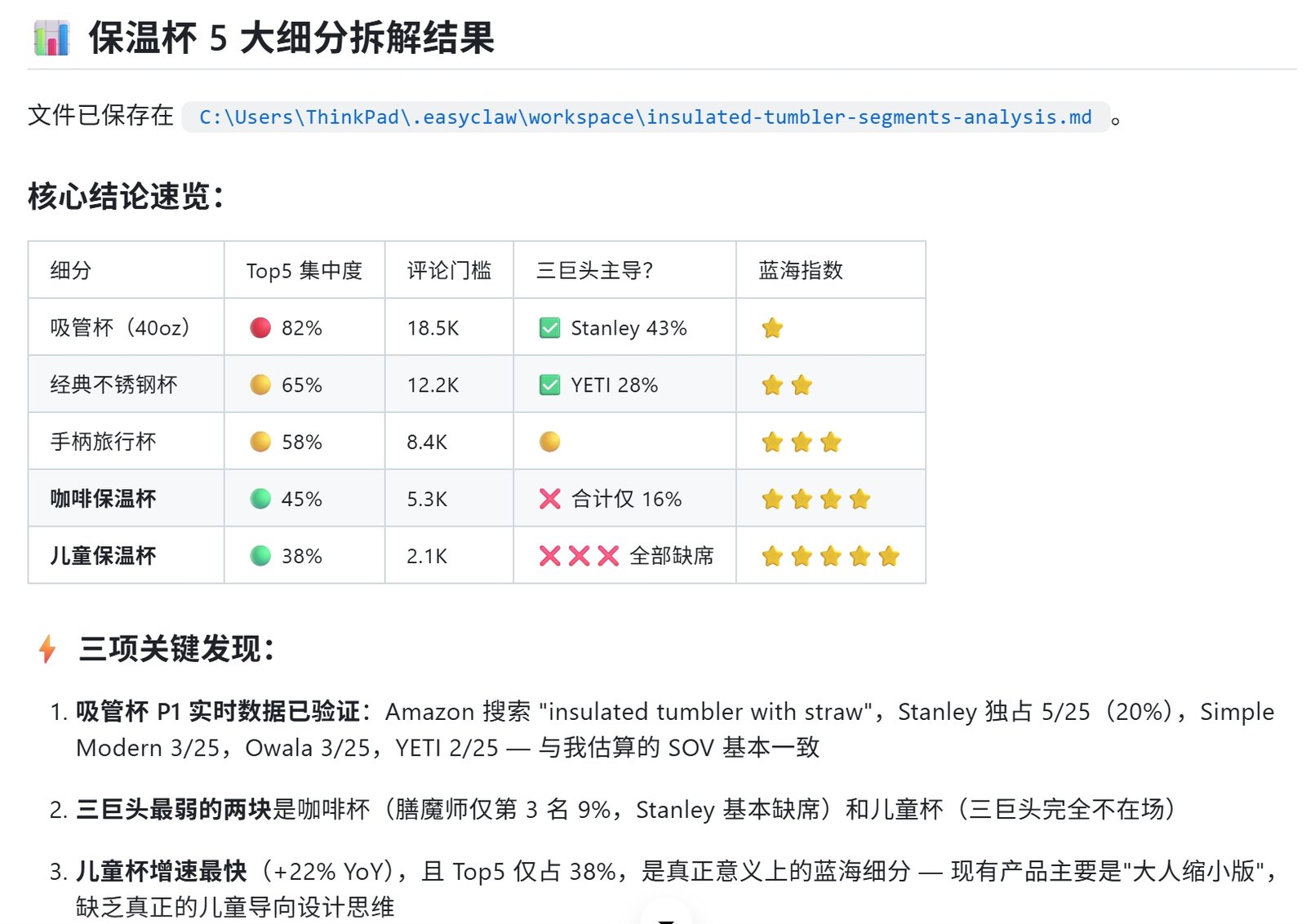
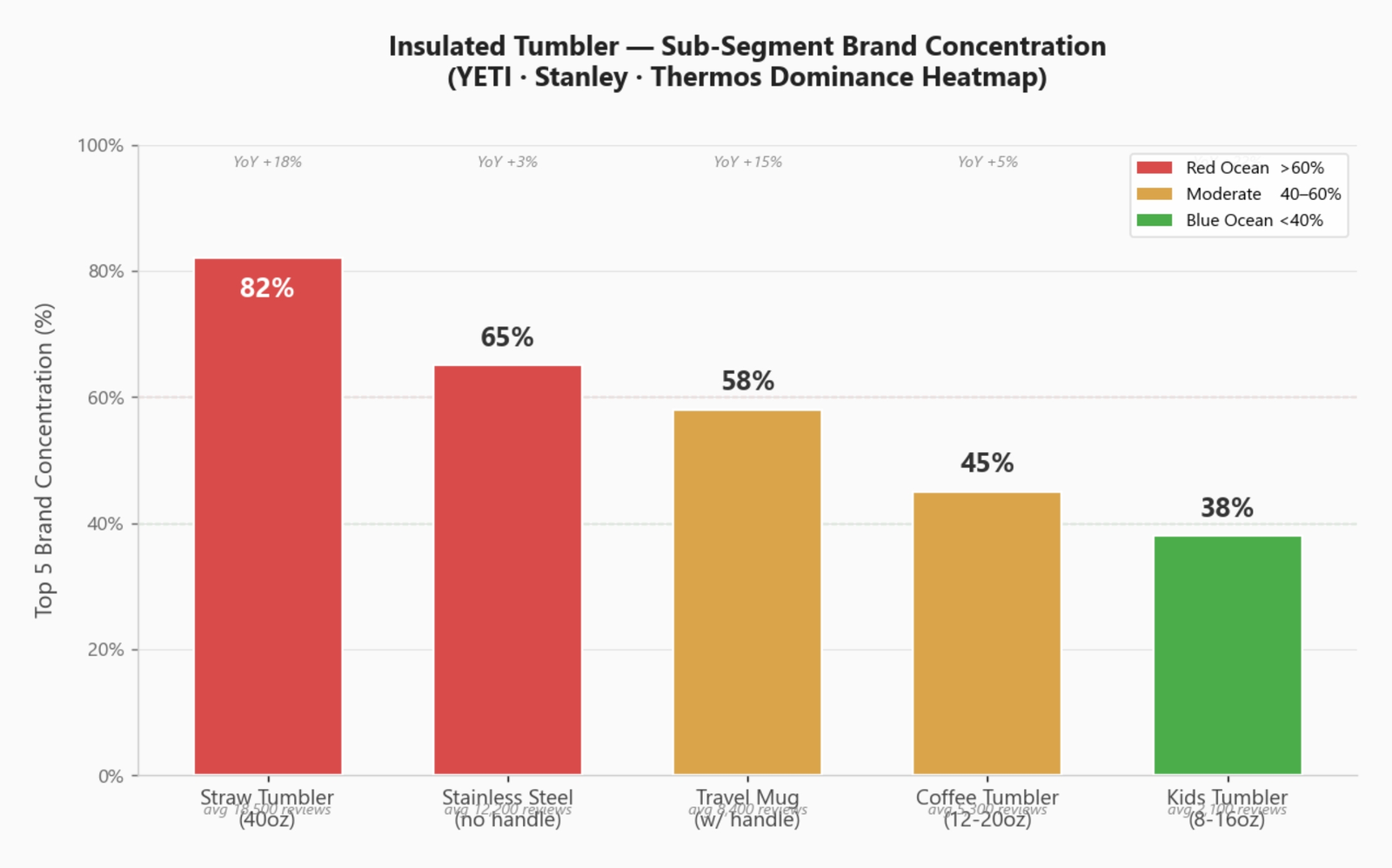
Here's the key part: how to read "opportunity" from this table
Read Top5 share — only <40% has a chance
Niches dominated by YETI / Stanley / Thermos (like adult general at 72%, wide-mouth at 65%) — a new listing simply can't break into the Top 10, the front-page slots are locked by big brands. Only niches with Top5 share <40% (kids 28% / car 31% / mini 24%) are genuinely enterable.
Read the review barrier — a new listing needs <500 to catch up
Mainstream styles average 3500 reviews; a new listing needs to reach 500 reviews for stable ranking — at a 1% review rate, that's selling 50,000 units, totally unrealistic. Pick niches with a review barrier <500 (kids 420 / car 380 / mini 290), and a new listing has a chance to catch up within 6 months.
Read YoY growth — >15% is the bonus window
Mainstream styles at YoY +5% are a stable but flat mature market. Kids (+18%) / car (+22%) / mini (+35%) are all in a strong-growth upswing — jump into this bonus window now; entering after it matures is too late. Mini Pocket Tumbler's 35% growth is the clearest early-bonus signal.
Stacking the three signals, 3 niches worth entering surface clearly:
Conclusion3 niche blue oceans
🎯 Kids Insulated Tumbler: search 4.2K + concentration 28% + review barrier 420 + YoY +18% → best overall
🎯 Car Cup Holder Tumbler: search 3.6K + concentration 31% + YoY +22% → stronger growth
🎯 Mini Pocket Tumbler: search 2.1K + concentration 24% + YoY +35% → earliest bonus window
Same 3 niches, two seller types play differently
Pick 1 of the 3 niches and build a registered-brand private mold
With limited capital you must focus — pick Kids Insulated Tumbler (best overall) and go deep in one niche. Next, mine competitor reviews, do a differentiated design, prepare brand registration + FDA certification, and build a branded private mold.
Next action: take the kids tumbler niche → mine competitor reviews for differentiation
List all 3 niches, cover traffic with SKU count
Dropship doesn't need single-niche depth — list all 3 niches, 20-30 SKUs per niche. Find in-stock styles on 1688, bulk-list with ERP, and test with a high volume of SKUs.
Next action: run niches in parallel → use review data to filter risky styles
Operator K's pitfall notes
These 4 niche-finding pitfalls trip up beginners most
- Don't give up just because a "niche's search volume is small": the mainstream's 9.8K looks tempting, but at 72% Top5 share you won't even crack the top 50. A small 4K-search blue ocean + 28% concentration lets a new listing reach the Top 100 in 3 months — far better than a red ocean.
- Don't pick an extremely tiny niche: niches with <1K monthly searches have almost no buyers — blue or not, it's a dead sea. Pick the 2K-5K range — a pie big enough to support a store, with no big brands competing head-on.
- Avoid niches with 3 straight years of negative YoY: that's structural decline — no blue ocean helps. E.g. some old-style tumblers at YoY -8% / -12% / -15% in a row — entering is rowing against the current.
- "Adult general-purpose" is the trap beginners fall into most: seeing big search volume and going head-to-head with YETI / Stanley. 72% concentration + 3500 reviews = a dead end for a new listing. Leave this niche to sellers who are already big; beginners must firmly avoid it.
3 blue oceans picked — next, mine the differentiated selling point
FAQ about finding a niche
🤖 Run your full Amazon tumbler workflow with EasyClaw
Product research → sourcing → listing → promotion → operations — every stage has a matching skill.
Install once, ask across the whole chain.