How to Research Tumblers? I Scraped 5 Competitors' Reviews with Amazon Review Scraper and Found 3 Differentiation Opportunities
By step three of product research, you've judged the market and outlined your niche. The next unavoidable question: why would my tumbler sell better than the ones already on the BSR charts?
You can't answer this from gut — you have to mine the answer from one place: competitor reviews. Reviews are the real complaints customers write after spending money — the weakest spots of existing products, and your opening to differentiate.
What problem this step actually solves
"Mining reviews" sounds mystical, but it really just answers 3 questions:
- ① For tumblers that sell well now, what do customers complain about most?
- ② Of those complaints, which can be solved by product design, and which are expectation problems?
- ③ Can my tumbler improve on 1-2 of those pain points, so the listing can write a hook like "we solved XX"?
Why I stopped reading reviews manually
Three years ago I did it by hand too. Open the competitor page, sort by "recent" or "critical first," scroll one by one, paste a row to Excel when someone mentions leaking, another row for poor insulation…
❌ Manually reading reviews across 5 ASINs
· 50-100 reviews per competitor
· 5 competitors = a whole evening gone
· Pasted into Excel as plain text — can't see proportions
· Next day, tons mis-tagged and missed
· No confidence, can't make the call
✅ Using EasyClaw's Amazon Review Scraper skill
· 1 natural-language command
· 5 ASINs scraped in parallel
· 10 sample reviews each for a quick read
· Structured output: rating/title/body/date/type
· Total 2-3 minutes (depending on anti-scrape delay)
Why I don't use a pure scraper — I use EasyClaw
There are plenty of "review scraper" tools out there (Helium 10 / Jungle Scout both have similar features). But after a year of use, a scraper only solves half the problem — the other half is the key:
🛠️ Pure scraper tools
Scrape the reviews → hand you a JSON / CSV
→ the "make sense of the data" part is left to you
The biggest beginner pain: you've got a pile of reviews — how do you categorize them? High-rated competitors barely have any critical reviews, so where's the opportunity? How do you mine hidden pain points?
→ You're back to a whole evening of manual analysis — it didn't really solve the problem.
🤖 EasyClaw = "skill scrapes + LLM analyzes"
The Amazon Review Scraper skill pulls the raw JSON
→ EasyClaw's main LLM takes over that JSON and analyzes it
→ It tells you directly: which critical review matters most, what hidden pain points hide in the 4-5 star reviews, which pain points span multiple competitors…
This is what truly sets EasyClaw apart from a scraper — it doesn't just give you data, it tells you what the data means.
Here's how I had EasyClaw do this
Two steps: install the skill, then send the command.
📦 Amazon Review Scraper
Actual capability: calls EasyClaw's local engine, opens a browser and paginates to collect Amazon product reviews, outputting structured data. Each review returns 6 fields — rating/reviewer/title/date-location/body/type, with optional image URL/video URL. Built-in 3-8 second random anti-scraping delay.
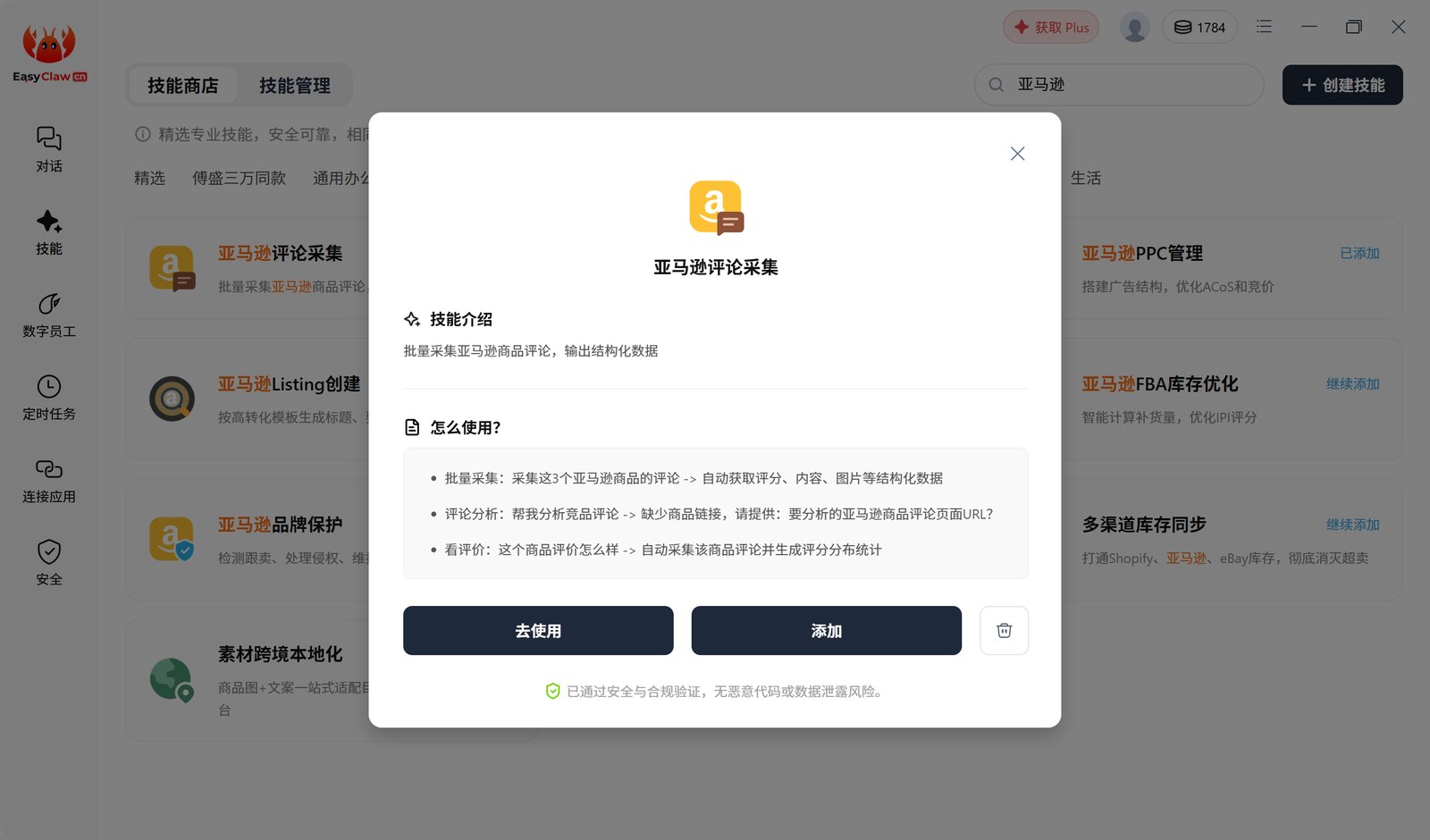
Use Amazon Review Scraper to pull 10 reviews from each of these 5 tumbler ASINs, focusing on 1-3 star critical reviews.
EasyClaw automatically converts the ASINs into review-page URLs (with the reviewerType=all_reviews parameter) and scrapes them in parallel via the browser engine.
What the skill brings back
After the run, Amazon Review Scraper returned structured review data for each ASIN, each review carrying 6 fields — rating, reviewer, title, date-location, body, review type (with optional image/video URLs). The skill only "scrapes data" and is strictly forbidden from fabricating — if it can't fetch, it errors out.
But raw data is inert. The real value is the next step: having EasyClaw read, categorize, and mine hidden pain points from the praise.
After EasyClaw takes over the data, it does the categorization itself
I continued to EasyClaw:
EasyClaw's main LLM (no extra skill needed) did a second-pass analysis on this data and output a categorized report. The result was unexpected — all 5 competitors rate 4.4-4.7, with almost no critical reviews:
| ASIN | Product | ★Rating | Total reviews | 1-3 star |
|---|---|---|---|---|
B0GJS619G5 | Konokyo FLOWPLAY Push-Button 18oz | 4.7 | 35 | 0 |
B0F6C5GQ4T | KEWIXY Cherry Water Bottle 18oz | 4.5 | 153 | 0 |
B0FF9MMXM6 | Halloween Tumbler 40oz | 4.4 | 182 | 1 (3★) |
B0G4CDM3QN | Dog Affirmation Tumbler 40oz | 4.6 | 526 | 0 |
B0GKQYGY2J | BrüMate Era Flip 30oz | 4.5 | 530 | 0 |
The only critical review (B0FF9MMXM6 · 3 stars)
"The straw keeps falling off the lid into the cup, very disgusting. Keeps drinks cold fine, but the straw issue is too annoying."
Even more valuable — EasyClaw also mined a batch of "praise-while-griping" hidden pain points from the 4-5 star reviews, categorized them by proportion, and gave entry suggestions:
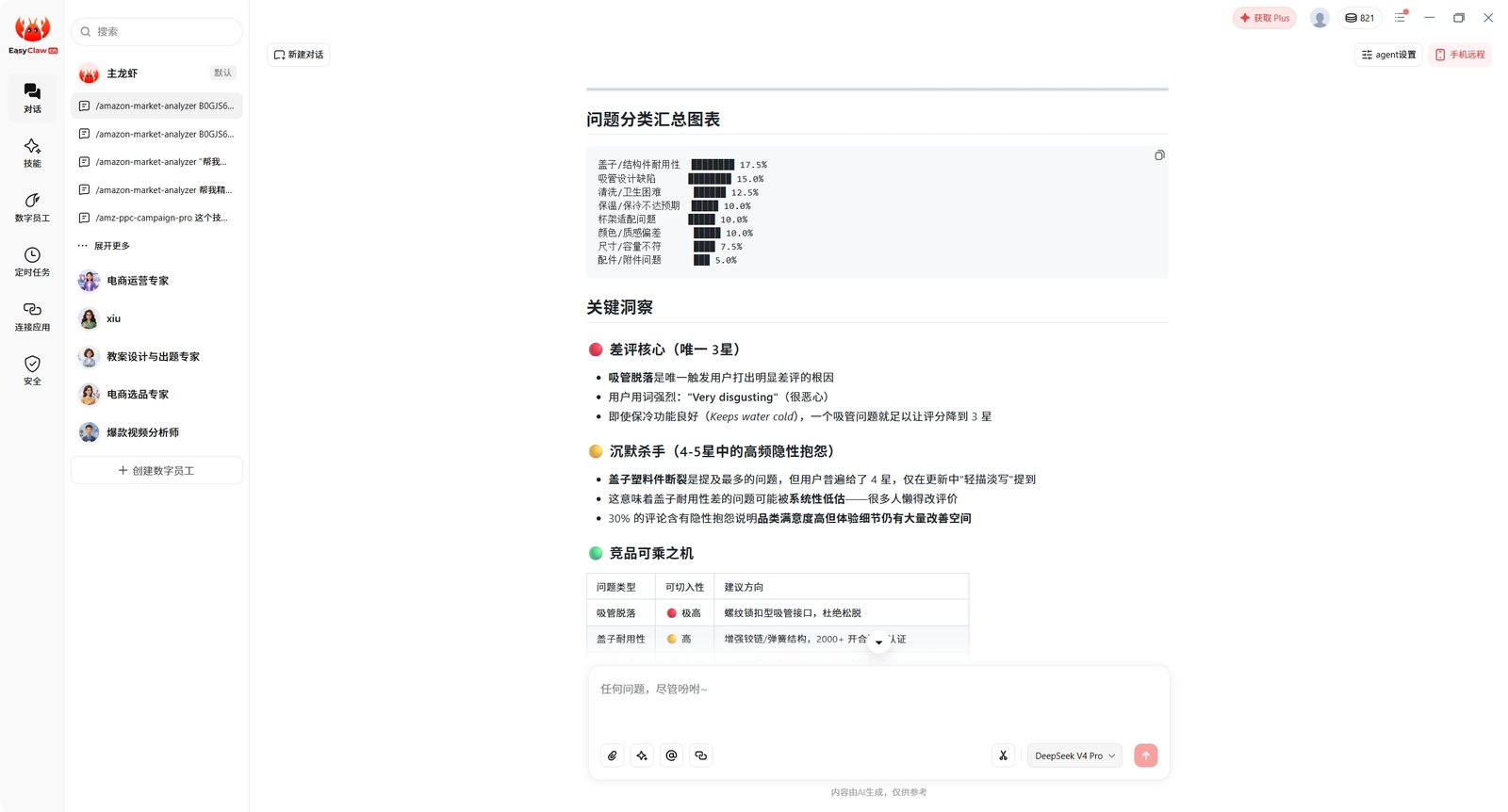
Below is the text version of this report (for easy citation and search-engine indexing). First, the proportion distribution across 8 problem types:
| Problem type | Share | Severity |
|---|---|---|
| Lid / structural part durability | 17.5% | High |
| Straw design defect | 15.0% | High |
| Cleaning / hygiene difficulty | 12.5% | Medium |
| Insulation / cold retention below expectation | 10.0% | Medium |
| Spout odor | 10.0% | Medium |
| Color / texture deviation | 10.0% | Low |
| Size / capacity mismatch | 7.5% | Low |
| Accessory / attachment issues | 5.0% | Low |
Now the three layers of key insight EasyClaw gave — this is what sets it apart from a pure scraper:
🔴 Critical-review core (the only 3-star)
- The straw falling off is the only thing that drove an obviously critical review
- Strong wording from the user: "Very disgusting"
- Even with good insulation (keeps water cold), a single straw issue was enough to drop the rating to 3 stars
🟡 Silent killer (frequent hidden complaints in 4-5 star reviews)
- Lid plastic parts cracking is the most-mentioned issue, but users generally still gave 4 stars and only mention it "in passing"
- This means poor lid durability may be systematically underestimated — many people don't bother updating their review
- 30% of reviews contain a hidden complaint, indicating high category satisfaction but plenty of room to improve experience details
🟢 Competitor openings (entry suggestions)
| Problem type | Entry potential | Suggested direction |
|---|---|---|
| Straw falling off | Very high | Threaded-lock straw interface to eliminate loosening |
| Lid durability | High | Reinforced hinge / spring structure, certified for 2000+ open-close cycles |
Here's the key part: how to read "opportunity" from this table
High-rated niche — opportunity hides in the "praise-while-complaining"
These 5 competitors rate 4.4-4.7 with almost zero critical reviews — a beginner would judge "no opportunity." But "straw not leak-proof / leaks" was mentioned 3 times in the 4-5 star praise, across 2 ASINs. Users willing to give 5 stars still can't help griping — that signals a "grin-and-bear-it" real pain point, exactly the entry point.
See how many competitors a pain point spans
"Straw leaking" and "lid plastic cracking" each span 2+ ASINs — meaning it's not a single product's fluke but a category-wide common problem. A category-level common problem is far more valuable than a single-product defect: solve it and you differentiate against the whole niche, not just beat one competitor.
Read the user's exact words to reverse-engineer the hook
The only critical review's exact words were "the straw keeps falling off the lid into the cup" — users can precisely describe the "straw falling off" action, meaning they're aware of the straw structure. My future listing hook is set: "Secure Lock Straw — Never Falls In". A selling point reverse-engineered from real user language is 10× stronger than a vague term like "high-quality tumbler."
Stacking the three signals, I reach this round's differentiation conclusion:
🎯 Entry point = solve the two category-level common problems "straw falling off / leaking + flimsy lid plastic."
Hook = anti-falloff lock straw design + reinforced lid clasp + leak-proof seal structure.
Same data, two seller types decide completely differently
At this point, "mining the differentiation opportunity" is done. But how you use it diverges completely between premium FBA and dropship.
Turn hidden pain points into a product redesign spec
Take this "straw leaking 3× / lid cracking 2×" data to a 1688 factory and tell them clearly: "I want an anti-falloff lock straw, a reinforced lid clasp, and it must pass both drop and seal tests." Sample 3-5 versions and test, then make a branded private mold once finalized.
Next action: take the differentiated selling point → find a 1688 factory to sample → test against competitors → finalize
Treat hidden pain points as a "negative list" for selection
You can't change the product, but you can pick styles that won't blow up. When sourcing on 1688, use "straw falls off easily," "thin lid plastic," "leaks" as exclusion terms, and only pick styles rated 4.6+ where the buyer photos show a straw lock structure and a thick lid.
Next action: use hidden pain points in reverse → filter when sourcing on 1688 → list reliably-reviewed in-stock styles
Operator K's pitfall notes
I've fallen into these 4 traps myself — don't repeat them
- Only looking at 1-3 star reviews: this time the 5 competitors had almost 0 critical reviews — anyone looking only at critical reviews gives up immediately. The real gold mine is the "praise-while-griping" in 4-5 star reviews — have EasyClaw scrape the praise too and analyze hidden pain points.
- Treating a single-product defect as a niche opportunity: an issue appearing once on one ASIN may be a fluke. Check whether the pain point spans multiple competitors — only those across 2+ ASINs are category-level common problems worth differentiating on.
- Not reading the user's exact words: a category label ("leaking") is abstract; the user's exact words ("the straw keeps falling off the lid into the cup") carry product-design direction. Extract listing hooks from the exact words.
- Treating every gripe as an opportunity: "color differs from the photo" or "slow shipping" are expectation-management problems, not product defects — redesigning won't fix them. Only pick pain points you can improve at the design/craft level.
Differentiation opportunity found — next, run the numbers
FAQ about Amazon Review Scraper
🤖 Run your full Amazon tumbler workflow with EasyClaw
Product research → sourcing → listing → promotion → operations — every stage has a matching skill.
Install once, ask across the whole chain.